
EUDR customs requirements
Revenue update for Irish importers and exporters
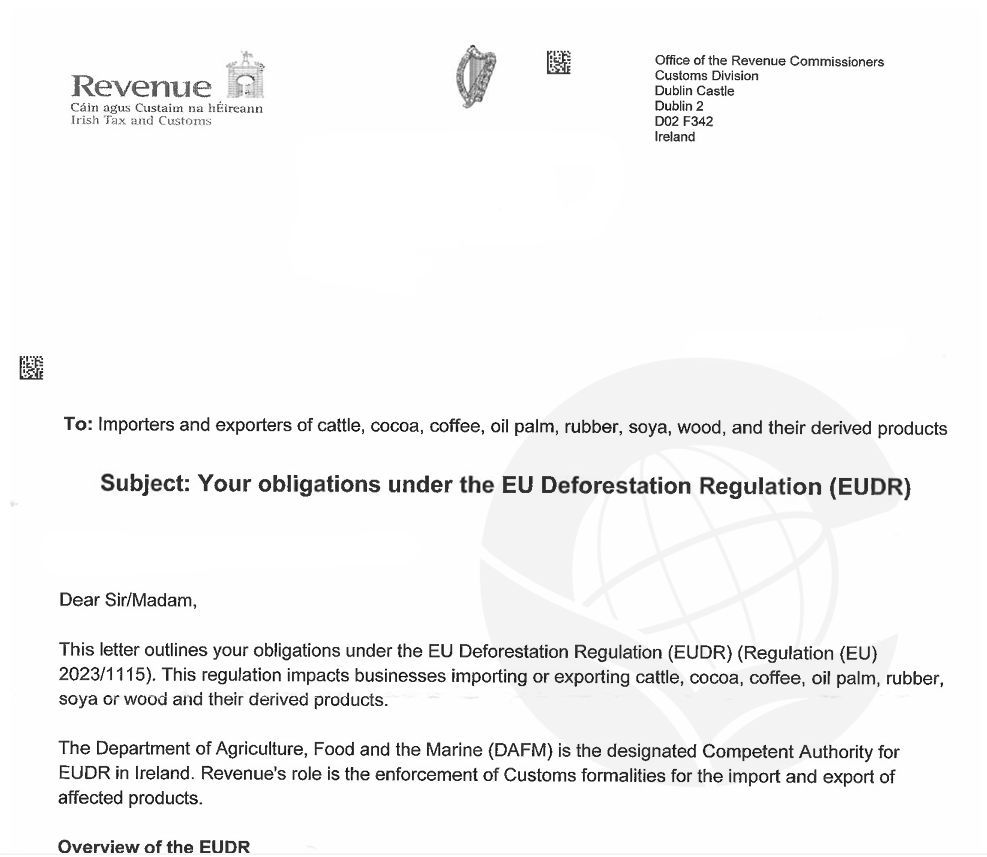
Revenue has written to Irish importers and exporters of cattle, cocoa, coffee, oil palm, rubber, soya, wood, and derived products to set out their EUDR customs requirements.
From 30 December 2026, EUDR compliance will have a direct impact on customs declarations and the release of goods. Businesses moving in-scope products must have the required due-diligence information and reference numbers ready before filing.
EUDR application dates
- 30 December 2026: main EUDR obligations apply to large and medium operators, traders, and products currently covered by the EU Timber Regulation
- 30 June 2027: obligations extend to most micro and small operators for commodities other than wood
Businesses should confirm their size, role, and product scope now to establish which obligations apply and when.
EUDR customs declaration requirements
For relevant imports and exports, the customs declaration must include the EUDR due-diligence statement reference number, or the applicable TARIC exemption.
Revenue states:
“Revenue will not release a consignment if the reference number or TARIC code exemption is not provided. Revenue will also not release if DAFM requires a compliance check.”
A missing reference number can therefore prevent the release of a consignment. Customs clearance also does not confirm that a business has met its wider EUDR obligations.
EUDR readiness actions
Businesses should have the following in place before the December deadline:
- Identify affected products, HS/CN codes, and supply-chain flows
- Confirm the company’s role as an operator, downstream operator, or trader
- Collect supplier evidence on origin, geolocation, legality, and deforestation-free production
- Register for and test the EU Information System
- Ensure customs agents can include the correct reference number or exemption in declarations
- Retain records for at least five years
The obligation depends on the role in the supply chain. Businesses that first place relevant products on the EU market, or export them, generally submit a due-diligence statement and receive a reference number. Downstream operators and traders generally need to obtain, retain, and make available the relevant reference where required.
EUDR customs readiness checklist
Businesses should be able to answer the following before 30 December 2026:
- Can you identify every in-scope product and shipment?
- Do you have the supplier data required to support due diligence?
- Can you generate and share the correct reference number before customs filing?
- Do your customs agents know what to include in each declaration?
- Can you retrieve records if DAFM or Revenue requests them?
For businesses with regular imports or exports of covered commodities, these are core operational requirements, not optional preparations.
Support with EUDR customs requirements
Carbon Complete supports businesses with practical EUDR compliance, including supply-chain data collection, due diligence, due-diligence statements, and customs readiness.


